 OptiLinker
The China Top 10 100G QSFP28 Module Suppliers guide examines a market built around speed, density, and dependable optical performance. China’s suppliers serve data centers, telecom networks, cloud platforms, and enterprise systems. Their products may look similar on a specification sheet. Real differences appear in testing, firmware support, thermal control, and delivery consistency.
Dr. Peter J. Winzer, a leading optical-communications expert, has said, “Optical communications is the backbone of the Internet.” His observation remains relevant as 100G links carry traffic through compact switches and crowded server rooms. A reliable 100G QSFP28 module must maintain stable transmission across suitable distances. It should also support practical standards, accurate monitoring, and predictable interoperability. Small details matter. Connector cleanliness matters. Heat matters too.
This overview compares ten notable Chinese suppliers through an evidence-based lens. It considers product range, compliance documentation, manufacturing experience, customization capability, quality controls, and customer support. Public information is not always complete. Some rankings may change as suppliers update platforms, certifications, or production capacity. That limitation deserves attention. Buyers should verify test reports, warranty terms, optical budgets, and compatibility before placing large orders. Price alone can mislead. A lower quotation may hide weaker validation or slower technical response.
The goal is not to declare one universal winner. It is to help network planners, distributors, and system integrators identify suppliers worth deeper evaluation. Each company should be judged against the installation’s actual requirements, not marketing language.
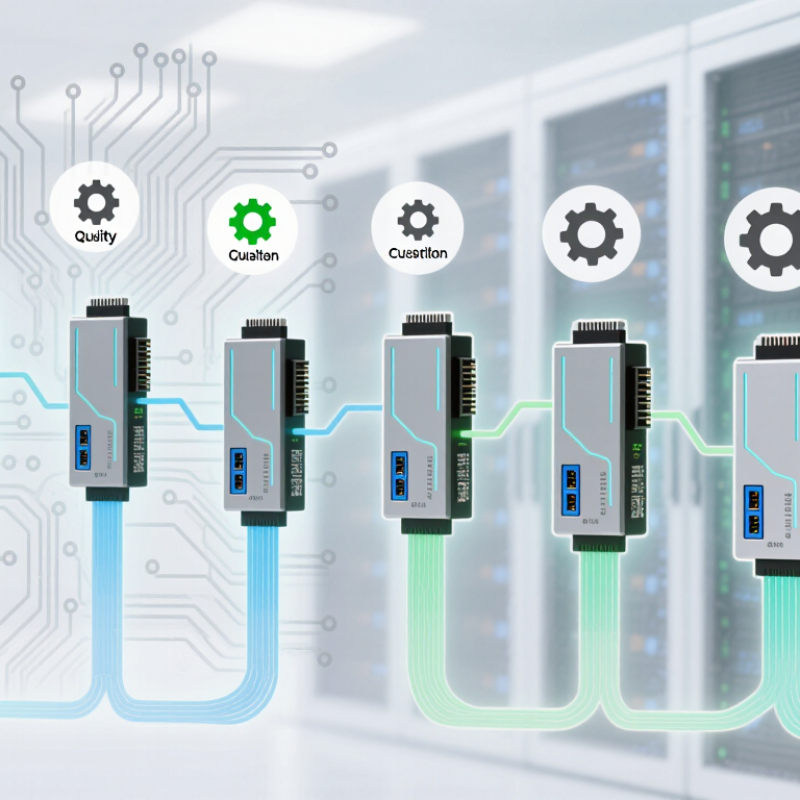
China Top 10 100G QSFP28 Module Suppliers?
100G QSFP28 modules use four 25G electrical lanes, matching the IEEE 802.3 standard architecture. Each lane carries about 25.78 GBd in practical deployments. Reach depends on optics, fiber, and error correction. SR4 commonly reaches 70 meters on OM3 multimode fiber and 100 meters on OM4. PSM4 can extend to 500 meters, while CWDM4 typically reaches 2 kilometers. LR4 supports distances up to 10,000 meters over single-mode fiber.
These figures align with IEEE 802.3 specifications and the Optical Internetworking Forum’s implementation guidance. The Ethernet Alliance roadmap also shows that 100G remains widely used for server access, aggregation, and data-center interconnection. When comparing suppliers, buyers should verify lane coding, optical power, receiver sensitivity, temperature range, and digital diagnostics. A low-cost module may pass a short test yet fail under heat or long fiber runs. That detail is easy to miss.
Tips: Match the optic to the real distance. For 70–100 meters, multimode SR4 can reduce cost. For 2–10 kilometers, single-mode CWDM4 or LR4 is more suitable. Check interoperability with the switch platform before volume purchasing. Standards help, but field validation still matters. I would not trust a datasheet alone.
| No. | 100G QSFP28 Variant | Fiber / Connector | Optical Lanes | Lane Rate | Typical Reach | Common Standard or MSA | Typical Application |
|---|---|---|---|---|---|---|---|
| 1 | 100GBASE-SR4 | Multimode fiber, MPO-12 | 4 × 25G | 25.78125 GBd | 70 m on OM3 100 m on OM4 |
IEEE 802.3bm | Short-distance data-center interconnects |
| 2 | 100G PSM4 | Single-mode fiber, MPO-12 | 4 × 25G | 25.78125 GBd | Up to 500 m | 100G PSM4 MSA | Parallel single-mode links in data centers |
| 3 | 100GBASE-DR | Single-mode fiber, duplex LC | 1 × 100G | 53.125 GBd PAM4 | 500 m | IEEE 802.3cu | High-density 500 m single-mode connections |
| 4 | 100G CWDM4 | Single-mode fiber, duplex LC | 4 × 25G | 25.78125 GBd | Up to 2 km | 100G CWDM4 MSA | Cost-efficient data-center and campus links |
| 5 | 100GBASE-FR1 | Single-mode fiber, duplex LC | 1 × 100G | 53.125 GBd PAM4 | 2 km | IEEE 802.3cu | Single-lambda 2 km interconnects |
| 6 | 100GBASE-LR4 | Single-mode fiber, duplex LC | 4 × 25G WDM | 25.78125 GBd | 10 km | IEEE 802.3ba | Campus, metro-access, and data-center interconnects |
| 7 | 100G ER4 | Single-mode fiber, duplex LC | 4 × 25G WDM | 25.78125 GBd | Up to 40 km | IEEE 802.3ba | Extended-reach metro and service-provider links |
| 8 | 100G 4WDM-10 | Single-mode fiber, duplex LC | 4 × 25G WDM | 25.78125 GBd | 10 km | 100G 4WDM-10 MSA | WDM-based 10 km optical links |
| 9 | 100G QSFP28 DAC | Passive copper, twinax, QSFP28 ends | 4 × 25G electrical | 25.78125 GBd | Typically 1–3 m | SFF-8636 / SFF-8024 | Rack-level switch-to-server connections |
| 10 | 100G QSFP28 AOC | Active optical cable, fixed ends | 4 × 25G optical | 25.78125 GBd | Typically 3–30 m | SFF-8636 / SFF-8024 | Flexible short-reach rack and row interconnects |
It uses four electrical lanes. Each lane carries about 25.78 GBd in practical deployments. The design supports roughly 100G aggregate throughput.
SR4 usually reaches 70 meters on OM3 multimode fiber. It can reach 100 meters on OM4 fiber. Keep the distance realistic.
PSM4 can extend links to about 500 meters. It suits longer parallel-fiber connections. Check fiber quality and connector loss before deployment.
CWDM4 commonly supports up to 2 kilometers. It normally uses single-mode fiber and multiple wavelengths. Wavelength stability still matters.
LR4 supports distances up to 10 kilometers over single-mode fiber. It combines four wavelengths through wavelength division multiplexing. Test receiver sensitivity carefully.
SR4 targets short links using multimode fiber and an MPO connector. LR4 targets longer links using duplex single-mode fiber. Cable layout changes the decision.
Check lane coding, optical power, receiver sensitivity, temperature range, and digital diagnostics. Request insertion-loss and bit-error-rate results. Price alone is weak evidence.
Heat, long fiber runs, and connector loss can expose hidden weaknesses. A crowded cabinet may reach 70°C. A datasheet alone is not enough.
Inspect MPO polarity, cleanliness, and lane stability. One contaminated endface can disrupt several optical lanes. This small detail is easy to miss.
Compare compliance records, temperature data, monitoring accuracy, and independent optical tests. Confirm switch interoperability before volume purchasing. I would still validate samples onsite.
China’s 100G QSFP28 module market covers a wide range of optical networking requirements, from short-distance data center connections to long-distance transmission. Based on four 25G lanes, these modules commonly support reaches from approximately 70 meters to 10 kilometers, depending on the optical design. SR4 is suitable for short-reach multimode links, while LR4 and ER4 address longer single-mode applications. CWDM4 offers an efficient option for data center interconnection by combining multiple wavelengths within a compact form factor.
The leading Chinese suppliers can be evaluated through their MSA compliance, production capacity, optical performance, and supported transmission distance. Buyers should compare 100GBASE-SR4 performance at 70–100 meters with LR4 operation around 10 kilometers, while also reviewing bit error rate, temperature range, interoperability, testing procedures, lead times, and warranty terms. A careful selection process helps ensure stable deployment, predictable maintenance costs, and reliable network scalability across different operating environments.
