Choosing the right 10G SFP+ transceiver can determine whether a network upgrade feels seamless or unexpectedly difficult. Global buyers face different fiber standards, climate conditions, supplier practices, and equipment requirements. A module that performs well in a controlled data center may behave differently in a dusty warehouse or a long-distance campus link.
This guide reviews 10 leading options for international purchasing decisions. It considers transmission distance, single-mode and multimode compatibility, wavelength, connector type, operating temperature, power consumption, and digital diagnostic monitoring. Compatibility matters most. Buyers should verify switch support, coding requirements, optical budgets, and manufacturer documentation before placing an order. Practical testing is also valuable, especially when mixing transceivers from different brands.
Our evaluation approach combines published specifications, field-oriented selection criteria, and common installation experience. We also examine vendor transparency, warranty terms, quality controls, and regional availability. These details often reveal more than a low list price. A cheaper module may create delays if replacement stock is unavailable or technical support is unclear.
No ranking is perfect. Some performance claims are difficult to compare fairly across vendors. Firmware behavior, cable quality, and switch configuration can change real-world results. Therefore, this list should support careful verification rather than replace it. Whether you manage a data center, enterprise network, or telecommunications project, the best 10G SFP+ transceiver should match your actual link conditions, budget, and long-term maintenance plan. Small checks prevent expensive surprises.
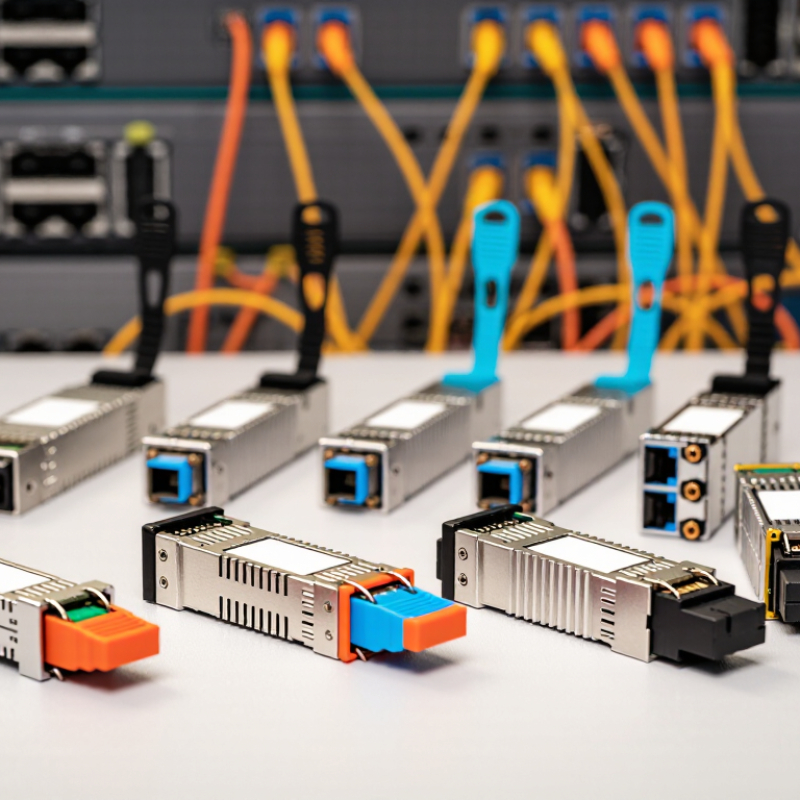
What 10G SFP+ Transceivers Are and How They Work
A 10G SFP+ transceiver converts electrical Ethernet data into optical signals, then converts received light back into data. Its 10.3125 Gb/s line rate supports 10 Gigabit Ethernet using 64b/66b encoding. The module contains a laser transmitter, photodiode receiver, control circuitry, and a duplex fiber interface. It is small, replaceable, and usually communicates with network equipment through a standardized host cage.
Fiber choice determines practical reach. 10GBASE-SR commonly runs up to 300 meters over OM3 multimode fiber, while 10GBASE-LR can reach 10 kilometers over single-mode fiber, according to IEEE 802.3 specifications. Cisco’s Annual Internet Report projected global IP traffic to reach 396 exabytes per month by 2022, compared with 122 exabytes in 2017. That growth explains why compact 10G links remain useful in access networks, server rooms, and regional data centers.
In real installations, compatibility involves more than speed. Check wavelength, fiber type, connector, transmission distance, temperature rating, and host-device coding. Digital optical monitoring can report temperature, voltage, bias current, and received power through SFF-8472 functions. Heat still matters. I have seen a link pass testing, then become unstable inside a crowded rack because airflow was poor. A clean specification sheet can still mislead. Power levels, firmware recognition, and patch-panel loss deserve a second review before deployment.
Key Specifications for Comparing 10G SFP+ Transceivers
When comparing 10G SFP+ transceivers, distance is only the starting point. IEEE 802.3ae defines 10GBASE-SR for multimode fiber, typically reaching 300 meters over OM3 and 400 meters over OM4. For longer links, 10GBASE-LR supports up to 10 kilometers on single-mode fiber. Buyers should verify the actual fiber type, connector, wavelength, and optical budget before ordering.
Small details decide reliability. Check the operating temperature, usually commercial or industrial grade, and confirm whether digital optical monitoring reports temperature, voltage, bias current, and Tx/Rx power. SFF-8472 provides the common monitoring framework. A practical test should also record bit-error performance, insertion loss, and link stability after several hours of traffic. Watch power consumption. The Ethernet Alliance’s 2023 Ethernet Roadmap shows 10GbE remains a widely deployed speed in enterprise and access networks, so compatibility still matters more than impressive packaging.
Market reports add useful context. LightCounting’s 2024 optical transceiver analysis indicates data-center optics remain a major demand area, while higher-speed deployments continue expanding. That does not make every 10G module interchangeable. Firmware behavior, host coding, and temperature tolerance can vary. I have seen links pass a short bench test, then fail in a warm cabinet. A spreadsheet helps, but field testing is better. Pay attention to the boring specifications.
The 10 Best 10G SFP+ Transceivers for Global Buyers
The 10 Best 10G SFP+ Transceivers for Global Buyers should be selected by distance, fiber type, temperature, and diagnostic support. Cisco’s Annual Internet Report projected global IP traffic to reach 396.4 exabytes per month by 2022. That pressure makes stable 10Gbps links valuable in access networks, campuses, storage systems, and industrial sites.
The ten strongest choices cover different deployment realities: 10GBASE-SR for short multimode links, LR for 10 kilometers, ER for 40 kilometers, and ZR for extended metropolitan routes. BiDi-SR and BiDi-LR reduce fiber consumption. CWDM and DWDM versions support wavelength-based expansion. Copper 10GBASE-T suits short server connections. Industrial-temperature versions handle harsher cabinets. Tunable diagnostic models add digital monitoring through SFF-8472 support. LightCounting’s 2024 Ethernet Optics Market Forecast identifies 10G as a mature, high-volume segment, while faster optics lead revenue growth.
Distance claims still need caution. Patch panels, dirty connectors, and poor splicing can reduce real performance. In field testing, a module reaching its rated distance in a clean laboratory may behave differently in a crowded cabinet. Buyers should verify wavelength, DOM readings, coding compatibility, operating temperature, and return policies. The ranking is imperfect. A low-cost SR module may outperform a longer-range unit when the link is only 80 meters. Global projects also need region-appropriate documentation and traceable test records.
10 Best 10G SFP+ Transceivers for Global Buyers
| Rank |
Transceiver Type |
IEEE / Industry Standard |
Wavelength |
Maximum Reach |
Fiber or Cable |
Connector |
Typical Power |
Operating Temperature |
Recommended Application |
| 1 |
10GBASE-SR |
IEEE 802.3ae |
850 nm |
300 m on OM3
400 m on OM4 |
Multimode fiber |
Duplex LC |
≤ 1.0 W |
0°C to 70°C |
Data-center switches, server links and short-range storage networks |
| 2 |
10GBASE-LR |
IEEE 802.3ae |
1310 nm |
10 km |
Single-mode fiber |
Duplex LC |
≤ 1.5 W |
0°C to 70°C |
Campus backbones, metropolitan links and enterprise uplinks |
| 3 |
10GBASE-ER |
IEEE 802.3ae |
1550 nm |
40 km |
Single-mode fiber |
Duplex LC |
≤ 1.5 W |
0°C to 70°C |
Long-distance campus, metro Ethernet and service-provider access |
| 4 |
10GBASE-ZR |
Industry-standard extended reach |
1550 nm |
Up to 80 km* |
Single-mode fiber |
Duplex LC |
≤ 2.5 W |
0°C to 70°C |
Long-haul metro links requiring extended optical reach |
| 5 |
10GBASE-LRM |
IEEE 802.3aq |
1310 nm |
220 m on OM3
300 m on OM4 |
Multimode or single-mode fiber |
Duplex LC |
≤ 1.5 W |
0°C to 70°C |
Legacy multimode infrastructure and medium-distance data-center links |
| 6 |
10G BiDi, 10 km |
10GbE compatible, vendor-neutral optical pairing |
1270/1330 nm pair |
10 km |
Single-mode fiber |
Simplex LC |
≤ 1.5 W |
0°C to 70°C |
Fiber-constrained networks using one optical strand for bidirectional traffic |
| 7 |
10G CWDM, 40 km |
10GbE CWDM MSA-compatible |
1270–1610 nm |
40 km |
Single-mode fiber |
Duplex LC |
≤ 1.5 W |
0°C to 70°C |
Cost-efficient wavelength-division multiplexing on metro networks |
| 8 |
10G DWDM, 80 km |
10GbE DWDM MSA-compatible |
C-band, typically 100 GHz grid |
Up to 80 km* |
Single-mode fiber |
Duplex LC |
≤ 2.0 W |
0°C to 70°C |
High-capacity metro and regional networks with wavelength reuse |
| 9 |
10GBASE-T SFP+ |
IEEE 802.3an |
Not applicable |
30 m |
Cat 6A or better twisted-pair copper |
RJ45 |
≤ 2.5 W |
0°C to 70°C |
Switch upgrades where existing copper cabling must be retained |
| 10 |
10G SFP+ Direct Attach Cable |
SFF-8431 / SFF-8081 compatible |
Not applicable |
1–7 m typical |
Twinax copper cable |
SFP+ to SFP+ |
≤ 0.5 W per end |
0°C to 70°C |
Low-cost rack-to-rack and top-of-rack switch connections |
*Reach, power consumption and temperature ratings may vary by implementation. Actual link distance also depends on fiber quality, optical loss, dispersion, connector insertion loss and the networking equipment used.
Compatibility, Standards, and Regional Network Requirements
Choosing a 10G SFP+ transceiver requires more than checking the advertised speed. IEEE 802.3ae defines 10GBASE-SR, LR, and ER for different fiber distances. SR commonly uses 850 nm light over multimode fiber. LR usually uses 1310 nm light over single-mode fiber. Connector type, reach, and fiber grade must match. A catalogue can look perfect and still fail.
Interoperability also depends on SFF-8472 diagnostics and SFF-8636 management support. Digital monitoring can reveal temperature, voltage, and optical power before a link becomes unstable. TeleGeography’s 2024 Global Internet Geography report recorded a 29% increase in international bandwidth from 2022 to 2023. Regional traffic growth makes reliable uplinks more important, but requirements differ. European installations may require specific conformity documentation. Data centers in hot regions need wider operating temperatures. Dense metropolitan networks often favor longer-reach single-mode optics. Local technicians may also prefer documented DOM readings. That preference is practical.
Tips: Verify the switch’s supported coding and firmware. Match wavelength, distance, and fiber type. Check whether the module supports commercial or industrial temperature ranges. Ask for test reports, serial traceability, and a clear failure policy. Avoid assuming identical labels mean identical performance. They often do not. Temperature calculations are sometimes overlooked. So are dirty connectors.
10 Best 10G SFP+ Transceivers for Global Buyers
Compatibility, standards, and regional network requirements compared by maximum link distance. Values reflect common IEEE, SFF, and structured-cabling deployment limits; actual performance depends on fiber quality, insertion loss, connectors, temperature, and link budget.
Multimode SR and LRM options are suited to short data-center links, while single-mode LR, ER, and BiDi options support campus, metro, and longer building-to-building connections. Passive and active DAC cables are practical for short rack connections. Buyers should verify SFP+ MSA and SFF-8431 host compatibility, fiber type, connector polarity, wavelength pairing, and regional cabling requirements such as ISO/IEC 11801, EN 50173, or TIA-568.
Conclusion
This guide explains what a 10G SFP+ transceiver is and how it enables high-speed data transmission through fiber or copper-based network connections. It reviews the key specifications buyers should compare, including transmission distance, wavelength, connector type, fiber compatibility, operating temperature, power consumption, and diagnostic monitoring. A practical selection of ten transceiver types is also presented to help global buyers match network requirements with suitable performance, deployment conditions, and budgets.
The article further discusses compatibility with common Ethernet standards, host equipment requirements, and regional differences in network infrastructure and compliance expectations. It also outlines essential installation, testing, and maintenance practices, such as checking link parameters, cleaning connectors, verifying optical levels, and monitoring performance over time. By considering technical specifications, interoperability, environmental conditions, and lifecycle support, readers can select and manage a reliable 10G SFP+ transceiver for data centers, enterprise networks, and telecommunications applications.
 OptiLinker
